
The great filter of indie game development
A seven-year development timeline
Good morning.
This week I examine a seven-year development timeline, how artistic uniqueness and commercialization conflict, and why a game’s name affects marketability.
Let’s get into it…
Crossing the great filter of indie game development
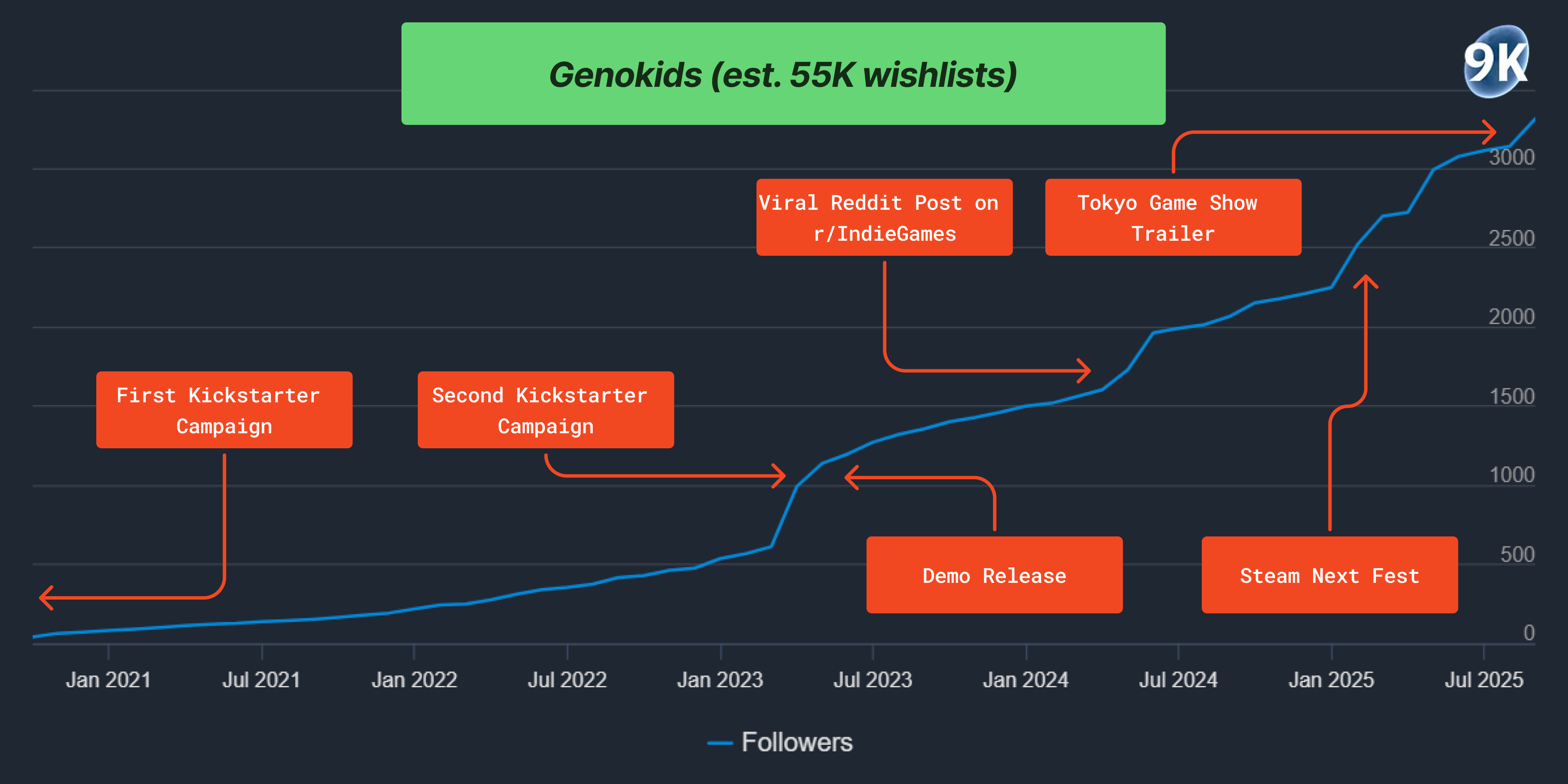
Nukefist, the two person team behind the upcoming Kingdom Hearts-inspired hack & slash, Genokids (releasing October 2nd with 55K est. wishlists), are nothing if not persistent. Their press release details that they started development in 2018/19. A year and a half later they launched a kickstarter campaign that ultimately failed to reach its goal of $35K. They continued to work on the game while contributing to a “fantasy adventure about an aspiring witch” called Mika and The Witch’s Mountain, which was co-developed with Chibig, the team behind Summer in Mara, and was released earlier this year with an estimated gross revenue of $385K. Nukefist then ran an entirely new Kickstarter campaign for Genokids in April 2023 to fund the completion of the game with their goal set again at $35K. This campaign exceeded their expectations bringing in $100K with over 1,500 backers. The additional funds allowed them to reach all of their stretch goals including adding voice acting and a Nintendo Switch version.
If Genokids performs well on Steam, it’ll be a storybook ending to a classically indie tale. Two friends follow their dreams and make the game they always wanted to against all odds. But this approach doesn’t typically turn out so well for most indies. As I covered in Six months or bust, long development timelines are incredibly risky. As your timeline grows, so do your costs. With more time comes increased pressure for outsized returns. And most games just don’t make enough money to cover 7 years of costs, even with Kickstarter funds in the bank. Between 2020 and 2023 only 50% of games released on Steam surpassed $500 in estimated gross revenue. In 2024, just 32% grossed over $500. As new indie developers continue to enter the market, I suspect that number will continue to shrink.
Spending 7 years working on one game sounds like an absolute nightmare to me. But maybe it’s a magic number of sorts. The 7 year threshold could be akin to The Great Filter, the hypothesized bottleneck in astrophysics that few civilizations clear before becoming spacefaring, and the explanation for why we haven’t come into contact with other intelligent life. Few can pass through The Great Filter.
There must be something driving Nukefist’s persistence. I would suspect it’s a deep appreciation for the hack & slash genre. But deep appreciation can only motivate you for so long. Not even indie darling Eric Barone spent 7 years working on his passion project turned megahit Stardew Valley. Ask the average indie developer why they make the games they do and they’re most likely to respond with one of the following: “I just want to make the game I would want to play” or “I couldn’t find the game I wanted, so I had to make it myself” or “I love game X and game Y, and wanted to see what would happen if you combine them”.
A recent YouTube video uploaded by Nukefist highlights that they fall into a couple of these camps, it’s titled: “No new Kingdom Hearts game in years so I made my own.” This video was just 48 seconds of gameplay and reached 64K views. The top comment reads:
So we’re combining KH [Kingdom Hearts] and DMC [Devil May Cry]? I absolutely get it. It’s a working formula. And I’m all here for it.
As I discussed in last week’s post about the slot machine roguelite CloverPit, it can sometimes be a winning strategy to be unabashedly direct about your influences. This works especially well if you nail the combination. It’s got to be clear and obvious.
Commercialization vs artistic uniqueness
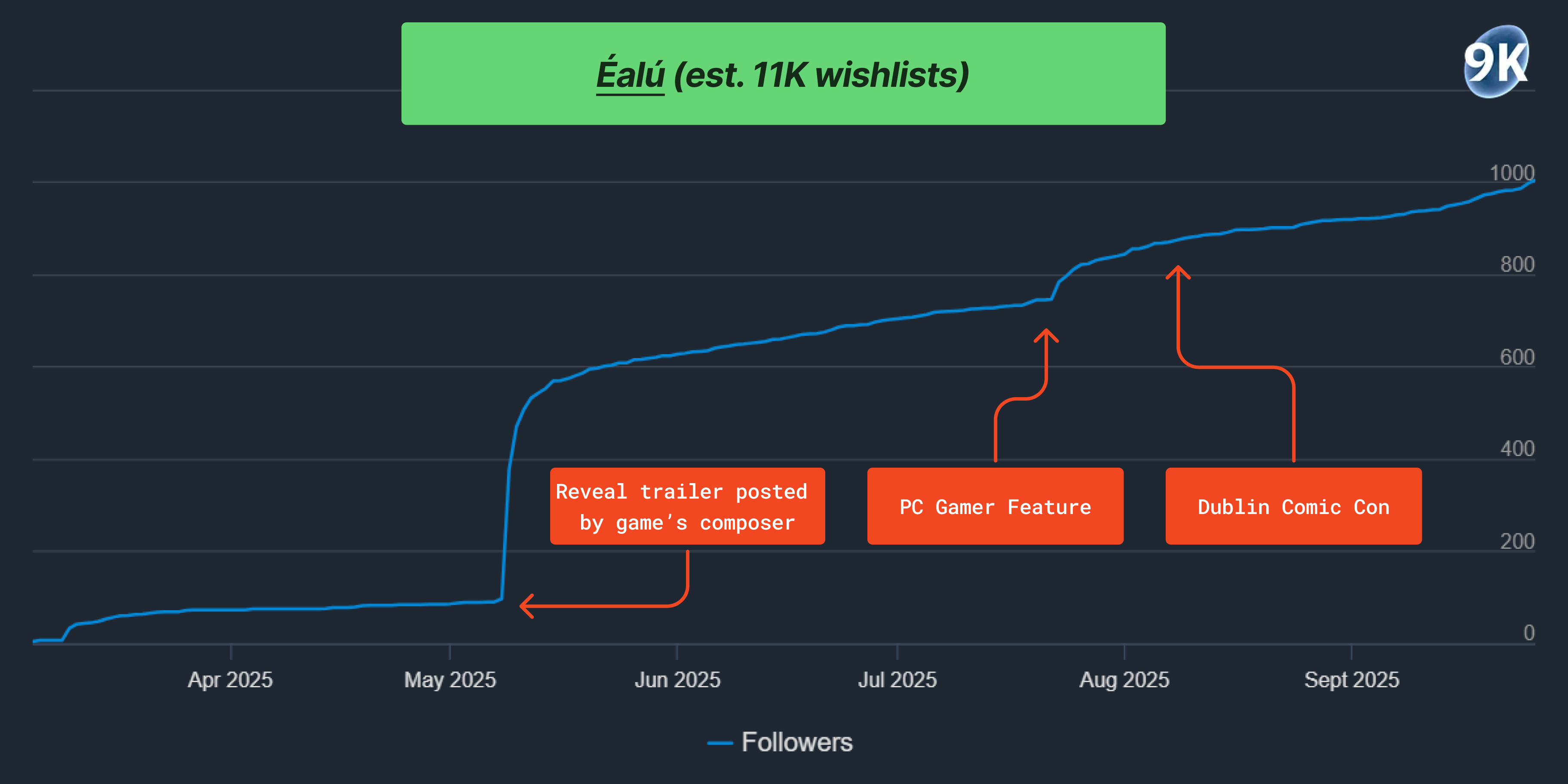
Éalú (releasing October 2nd with 11K est. wishlists) doesn’t appear to be a game made with commercial appeal in mind. It’s a point and click puzzle game, a genre that tends to have little appeal among streamers. It doesn’t have a demo. And the development process seems particularly laborious. The game is constructed entirely of real life props captured in stop motion. The Steam page explains:
Éalú is a true stop-motion game. Every animation was captured via photography frame-by-frame using real sets, hand-crafted props, and a physical wooden mouse. Over 512 video clips were painstakingly made by a single animator — mostly in a garden shed — and brought to life in Unity by one developer carefully ensuring that each movement flowed into the next.
Point and click puzzle games tend to have a hard time breaking through on Steam, but FMV games are among some of the best sellers. The genre has a median gross revenue of $4,200 compared to puzzle games with $680. It’s also far from oversaturated. There are 820 FMV games on Steam compared to 28K puzzle games. If you were to set out to make a market-informed FMV game you’d probably be inclined to make a dating sim like Love Is All Around, a detective game like The Operator or Her Story, or a horror game like recently released Dead Reset. 51% of FMV games are mystery games, 42% are story rich, 20% of them are horror, 19% are dating sims, and 12% are NSFW.
Most FMV games feature characters with backstories and developed arcs. Beyond the Bark, the team behind Éalú, instead set out to make an FMV game featuring a wooden toy mouse. While the game is tagged “Story Rich”, the story is left obscure according to the trailer. Rather than trying to fit within a proven framework for the genre, Beyond the Bark prioritize artistic uniqueness. As the Steam page explains, the game is purely fueled by passion:
Éalú was made with no budget & no crowdfunding. Just 4 people passionate about the project.
The team is “an animation, puppetry, production design and theatrical fabrication company based in Limerick.” Having come from “the arts” myself, I understand the impulse to traverse mediums. When I first started to make games, a few colleagues warned me that the history of the video games industry is littered with failed projects by people coming in wide-eyed from other mediums (movies, visual art, theater, animation, music, etc.)
Despite all this, Éalú has managed to reach 11K wishlists. Why? Artistic uniqueness can be a very strong hook in and of itself. But it doesn’t guarantee good reviews and sales. You still have to consider your genre conventions carefully. In the case of puzzle games, players can often bounce off of them rather quickly. A PC Gamer article previewing the game warns:
Speaking as a dumbass, it did not take long until the puzzles in the labyrinth really started to stump me
Some of the best selling puzzle games either have a crude art style, but are deeply systemic like Baba Is You and Stephen’s Sausage Roll. Or are beautifully vast and exploratory like The Witness or The Talos Principle. While aesthetically unique, Éalú is confined rather than vast, and the puzzles seem restrictive rather than deep.
What’s in a name?
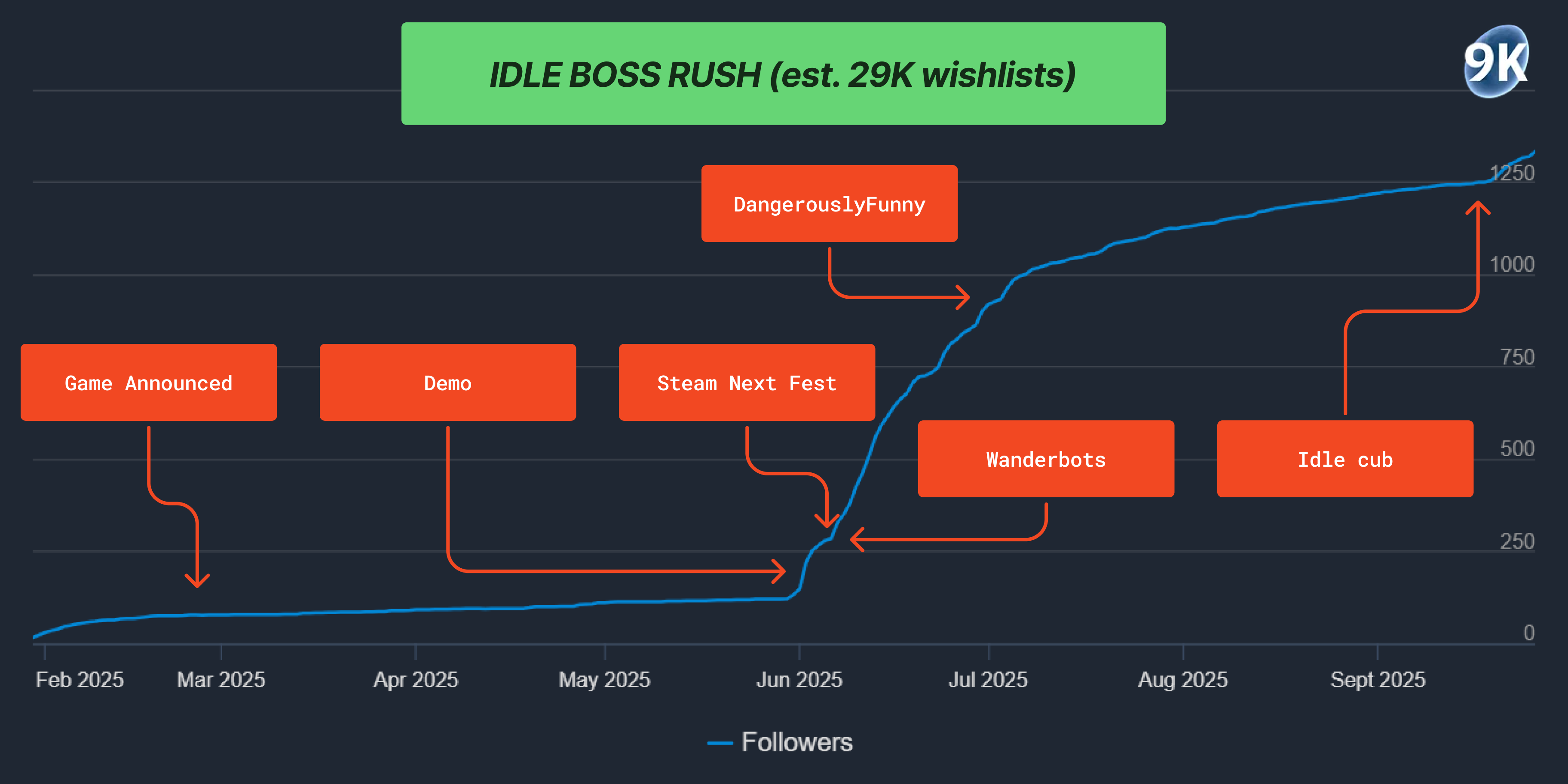
If you’re making a roguelike or idle game, there are a few niche but coveted YouTubers who can send your wishlist numbers soaring. Among these are Haelian, Wanderbots, ImCade, DangerouslyFunny, InterdotGif, Sifd, and Idle cub. All YouTubers who have played the upcoming idler/incremental game IDLE BOSS RUSH (releasing September 29th with 29K est. wishlists). More recently, breaking through the growing inboxes of even these niche YouTubers has become more difficult. Wanderbot explains in a recent feature on Push to Talk:
“My pitches per day have gone up massively since about 2019 or so,” he said in an email exchange. “Pre-2020, I felt great if I could find 1-2 new games per week that fit my interests/niche/bare minimum requirements for quality, which worked fine when I was still doing Let’s Plays. Post-2020, the sheer quantity of new releases is so high that I can only cover roughly 10-25% of games that fit those same criteria, and only as a one-off impressions video rather than a full playthrough.”
One thing that has changed dramatically in recent years is the popularity of “outreach lists” for content creators. Because Wanderbot has over half a million subscribers, his contact info is automatically included on many outreach lists.
[…]
Ultimately, the sheer number of new games has come to feel like a burden, even for someone like Wanderbot who is explicitly looking for new games to play and feature: “To be honest, I’m not really excited for how much the release numbers are scaling up for this year and going into the future,” he says. “The systems we have available just aren’t built for this kind of volume.”
So how do you break through? IDLE BOSS RUSH presents us with one possible strategy: a clear and obvious name that immediately positions your game within a genre. I don’t even have to look at the game description to understand what it is. I like the naming formula here of [GENRE] [CONCEPT]. This is something that games in the simulator genre have been doing for a while. Chris Zukowski has written about the importance of a clear name saying:
On Steam I think the most important thing a name does is give people the “vibe” of your genre and theme at a glance. Shoppers spend seconds scanning lists of games that are recommended to them. If they see a game that fits their favorite genre, they will click to read more.
Valve gives you just a few places where you can hint at your genre, so you need to be smart about it. Use a combination of Capsule (aka thumbnail), game title, and tags to get your genre across in those long lists of games.
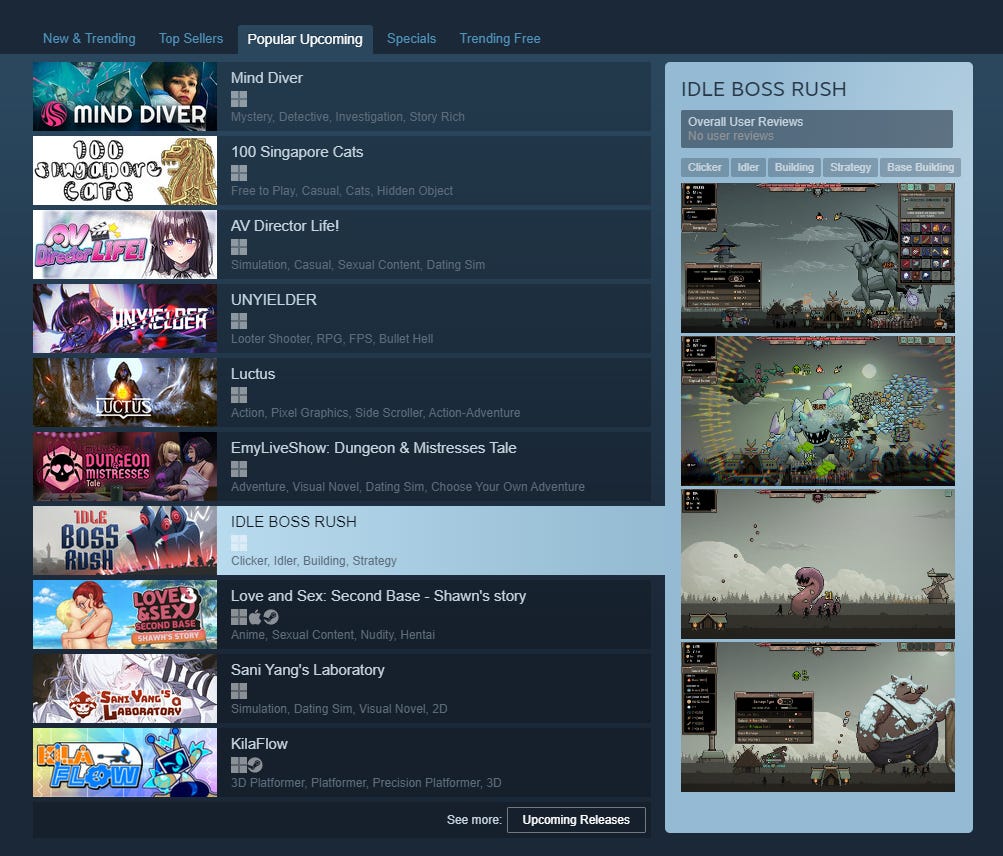
Irid Games, the team behind IDLE BOSS RUSH, seems to have, at least temporarily, pivoted away from working on their previous title, an early access roguelike-inspired tactics game called Dethroned. The game has reached just $10K in estimated gross revenue with 25 reviews at 76% positive. I’m sure far below the team’s expectations. Dethroned suffers from both genre confusion and, compared to IDLE BOSS RUSH, an unclear name. The Steam page reads:
Lead an army of mythical creatures through a dark fantasy world. In this genre-defying mix of tactics, adventure, and more, you’ll level up your hero, blast monsters with spells, loot and recruit. Explore an unpredictable, non-linear world, where you’ll face Dragons, Titans, Hydras, and... crabs?!
A “genre-defying mix of tactics, adventure, and more” is not specific enough. Put yourself in the shoes of a streamer or YouTuber who does niche, genre-specific let’s plays. You’re scrolling through your inbox looking for the next game to play on stream. You’re inundated with hundreds of emails per day. You see an email about a game called Dethroned and another one about a game called IDLE BOSS RUSH. Which one are you more likely to click?
Thanks for reading and have a great week.