
CloverPit and the fast follow approach
Should you be making devlogs?
Good morning.
This week there are 205 new releases1 on Steam. 95 are tagged as indie (46%) and 37 of those indies have released a demo (18%).
>10K wishlists: 16 indie, 13 with demo (81%)
1K-10K wishlists: 16 indie, 13 with demo (81%)
<1,000 wishlists: 63 indie, 11 with demo (17%)
This week I’m looking at a slot machine roguelite, an ultra-fast paced dungeon runner, and a semi-autobiographical life sim. Let’s get into it…
CloverPit
Estimated wishlists: 490K

Release date: September 26, 2025
Steam page created: 11 months ago
Demo info: Released April 10, 2025 / No available review data, demo store page was taken down by the developers
A rogue-lite slot machine nightmare. Gamble for your life in a never-ending debt simulator!
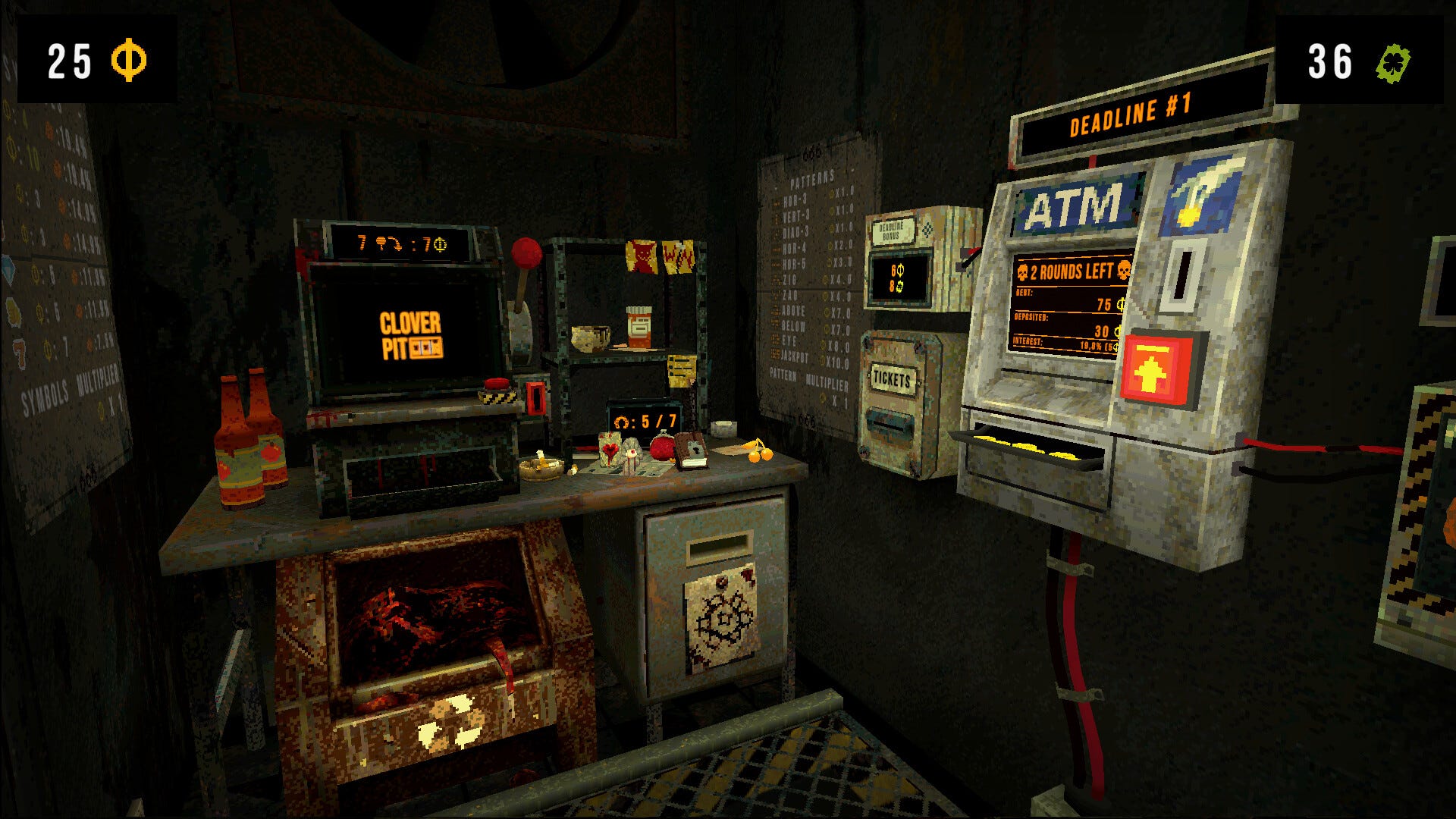
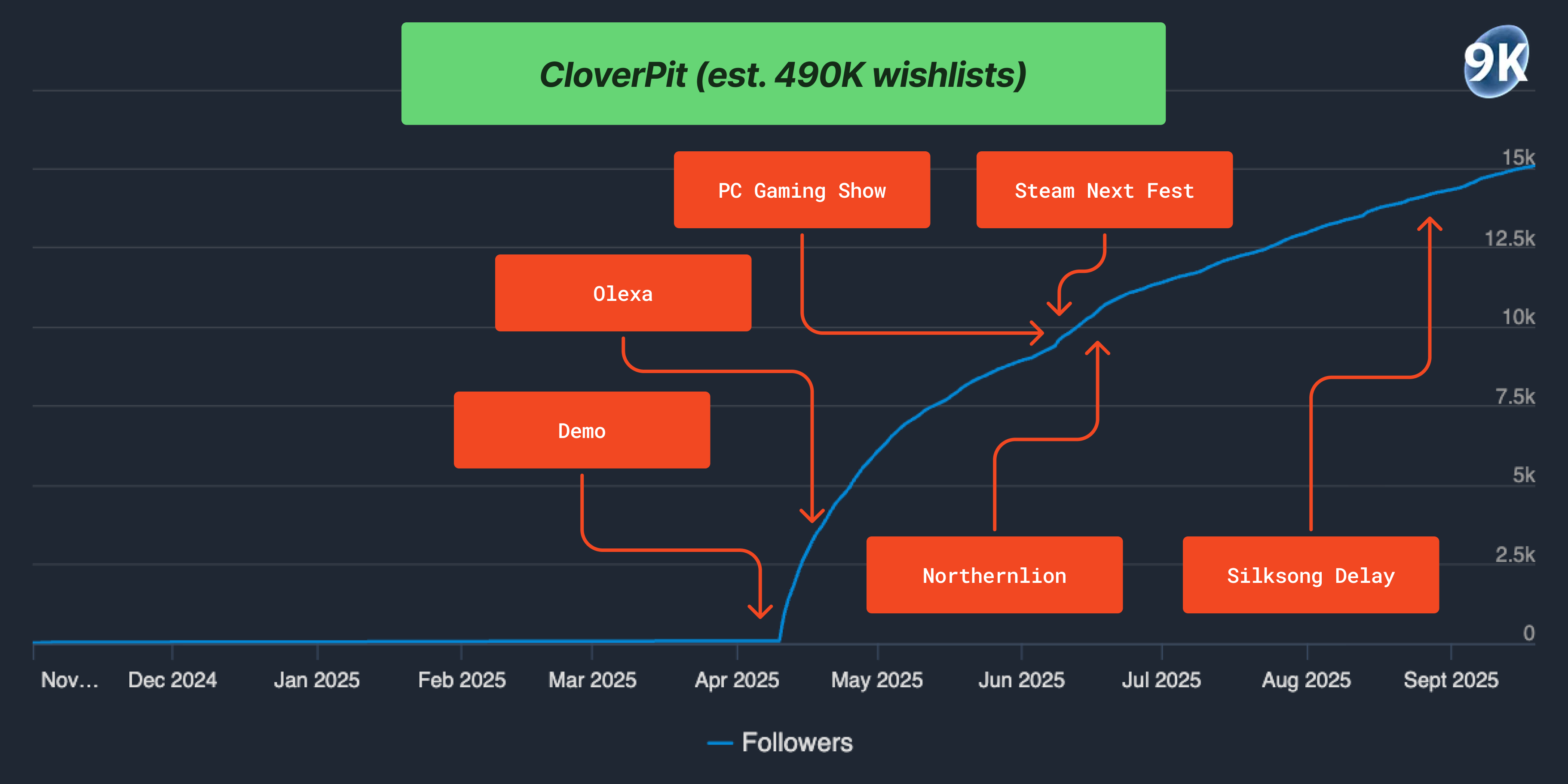
Twitch streamer Northernlion said in his first video featuring the CloverPit demo: “I guess it’s not even out yet, but still, the demo is better than 99% of the games I’ve ever played.” In a follow up video titled Can a demo be GOTY? he said “When the mechanics are good, it doesn’t matter that it’s a demo.” Since the game was announced in April, it has reached an estimated 490K wishlists.
I’ll admit, when I first saw the announcement for CloverPit in April, I had a feeling that it was a bit too on the nose, and maybe a little cloying. The developers, a duo called Panik Arcade, describe the game as “the demonic lovechild of Balatro & Buckshot Roulette.” At the time, it was common to see other indie developers lamenting about the coming onslaught of Balatro clones after it sold millions of copies. But, my first impressions were clearly wrong. The game’s unabashedly direct Balatro-like gambling concept seems to be what has caused it to circulate so widely. CloverPit demonstrates that players want more games like the other ones they love, not less.
It’s useful to look at CloverPit through the framework of the fast follow, a term Chris Zukowski uses to describe games that attempt to draw upon the hype of another recent hit game. Zukowski says:
Sometimes a game becomes a viral hit. It is a magical thing, it is a rare thing, and amazing to watch. A fast follow is a quickly-produced follow-up game made by a competitor to try and capture the ambient success of that viral hit game. A fast-follow is not a clone, but shares about 70% of the same DNA of that hit game.
The CloverPit demo was released 12 months after Buckshot Roulette and 18 months after Balatro. It’s not necessarily the fastest of fast-follows, games like Liar’s Bar quickly released within 6 months, but the long tail success of both games meant CloverPit could still tap into the lingering hype many months later.
CloverPit is connected to a whole range of slot machine-inspired roguelike games released since Luck Be a Landlord in 2021, which Balatro developer Localthunk described as one of his main inspirations. Among these are the creature collector variant Cat God Ranch (1.6K reviews) which places a cute, artistic veneer on top of the core slot machine mechanics, obfuscating them in some way. CloverPit, instead, wholly embraces the slot machine. The core game loop involves the player pulling a lever on a literal slot machine to make (fake) money and meet a threshold or else plummet to their death into the pit below.
CloverPit has successfully leaned into the deviousness of gambling, with its tongue in cheek description explaining “gamble for your life in a never-ending debt simulator!” In contrast, Balatro developer Localthunk has taken great care to disconnect his game from any association with gambling saying “I hate the thought of Balatro becoming a true gambling game”. CloverPit releases amidst a growing iGaming industry as popular sports betting apps FanDuel and DraftKings have released virtual casino apps with slot machine-style gambling games in attempts to expand beyond sports.
Not every player on Steam is clamoring for the latest gambling-inspired roguelike, but mass appeal shouldn’t concern you, as David Kaye describes in his recent post: “when you try to build something for everyone, you build something for no one.”
The median game on Steam sells 500 copies. The median SaaS product never breaks $10K MRR. They die not because they're bad, but because they're forgettable. They tried so hard not to offend anyone that they failed to delight anyone.
Meanwhile, products with sharp edges - products that actively repel certain users - create something more valuable than broad appeal: they create identity.
See also: GameDiscoverCo covered how the game reached 100K wishlists in one week back in April, other relevant “I’m trapped in a room” games include Inscryption, Buckshot Roulette, Five Nights at Freddy’s, Clickolding, Flathead, and upcoming games PVKK, Death In Your Dice, and Arsonate
Bloodthief
Estimated wishlists: 116K

Release date: September 22, 2025
Steam page created: 26 months ago
Demo info: April 16, 2024 / 555 reviews / 96% positive
Bloodthief is an ultra-fast melee dungeon-runner where you use momentum to parkour through hazardous dungeons and brutally slash through enemies. Speed-run through haunted dungeons and castles and learn what dark secrets lie beneath.
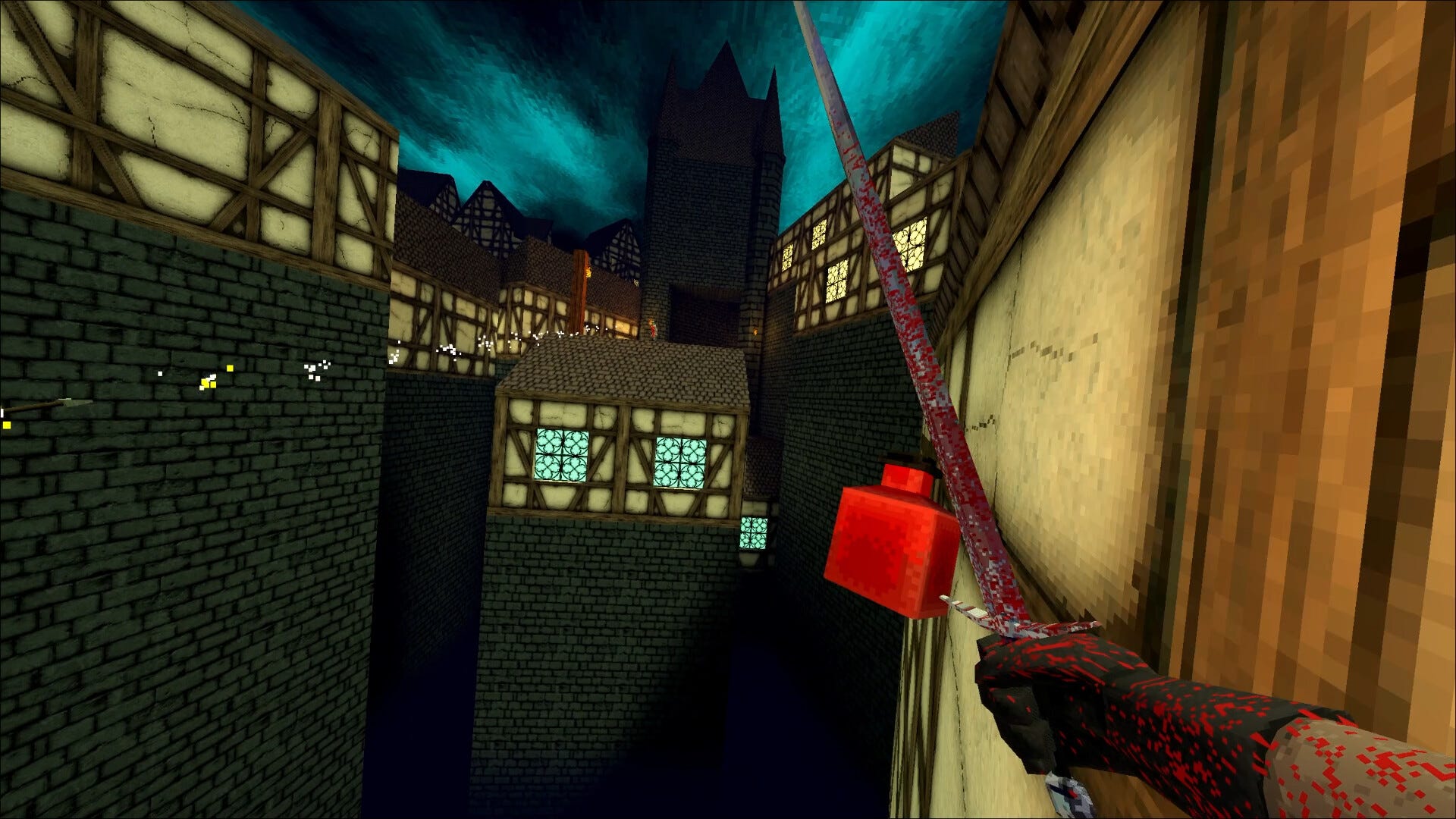
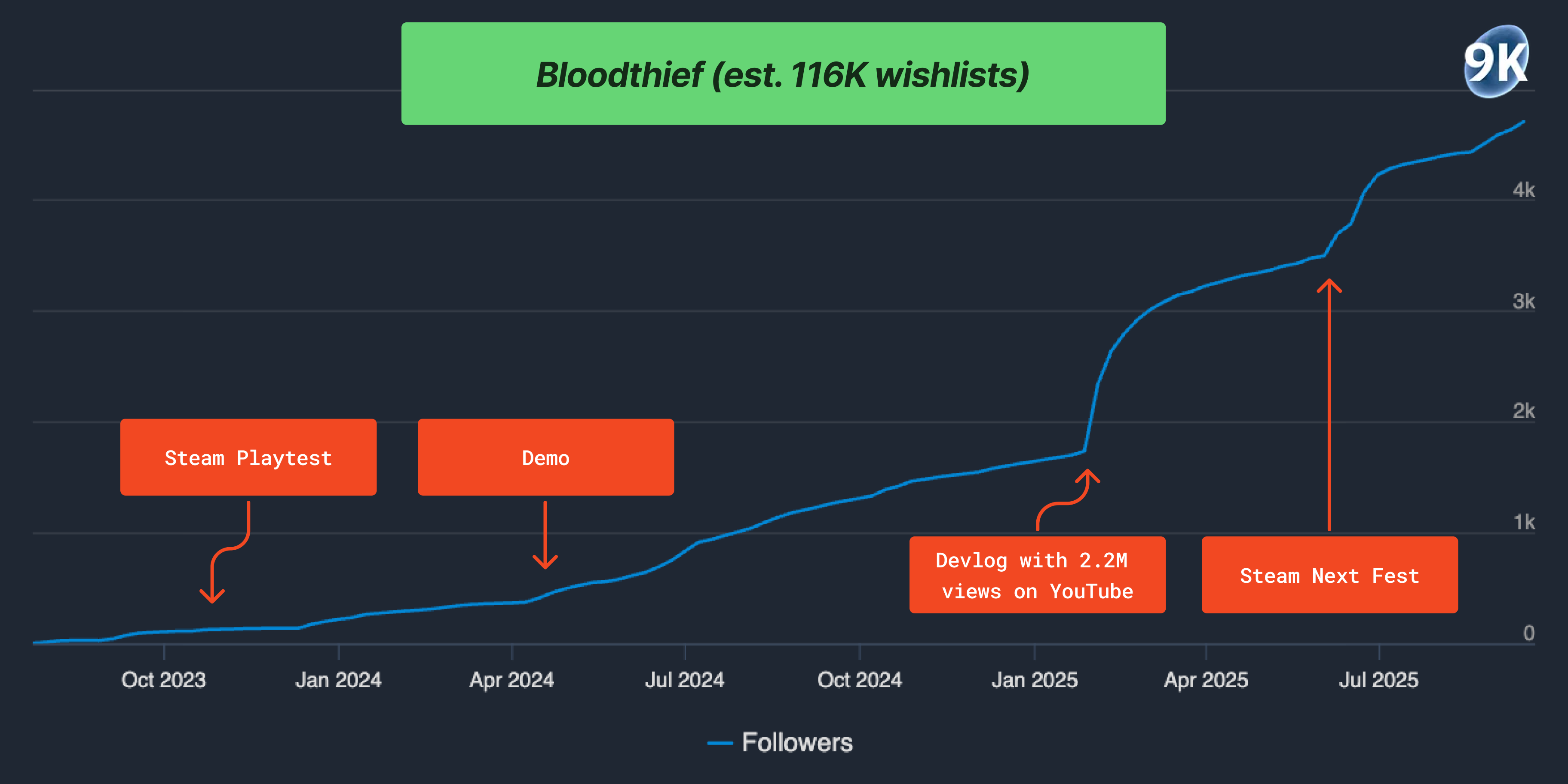
Should you be making devlogs? If you were to ask Bloodthief developer Blargis, he’d probably say yes. Over the past 2 years Blargis has posted 13 devlogs on YouTube, most of them between 15 to 20 minutes long, with his most popular video reaching 2.2M views and 83K likes. His steady growth in wishlists can be directly attributed to the success of his devlogs.
Blargis, who has a day job as a software developer, has been working on Bloodthief part time by himself since at least July 2023. He describes the game as inspired by “Neon White, Ghostrunner, ULTRAKILL, and of course, Quake.” The demo has reached 548 reviews with 96% a positive rating. The game was playtested throughout the very public development process with tight collaboration with players via a discord with over 7000 members.
Blargis took advantage of the often overlooked Steam playtest feature starting early in development in November 2023. Playtests on Steam are similar to demos in that they allow players to try out an early version of the game, but they’re much lower stakes as players expect to encounter bugs and little kinks in the game design here and there. Blargis created a tight marketing funnel with his devlogs serving as a way of getting people interested in the game enough to ultimately play the playtest, and later, the demo, and get involved in the community.
Choo-Choo Charles and CUFFBUST developer Gavin Eisenbeisz has good advice when it comes to creating devlogs. As he explains, your audience is not other game developers it’s your players. Eisenbeisz‘s devlogs for Choo-Choo Charles gained him over 200K wishlists. Many developers who set out to make devlogs end up making something halfway between a technical deep dive and tutorial instead of an entertaining video highlighting what’s fun about the game. Even some of the more popular game dev YouTubers make this mistake. David Wehle, developer of the upcoming farming sim horror game We Harvest Shadows (est. 264K wishlists), commented on Eisenbeisz’s devlog video saying:
This might be literally the best indie marketing video on YouTube, thanks so much Gavin. Pretty sure I mixed my audiences on my channel and now all my videos stagnate and get stuck. Not sure what to do honestly.
If you’re interested in making devlogs, remember your audience is your potential players, not other developers. Follow the format successfully and they can be a great way to market your game and grow a community. I’m looking forward to seeing if the millions of views that Blargis racked up for the Bloodthief devlogs convert to strong sales figures over the next few weeks.
Consume Me
Estimated wishlists: 38K

Release date: September 25, 2025
Steam page created: months ago
Demo: Released May 29, 2025 / 156 reviews / 99% positive
did you feel stupid, fat, lazy, and ugly in high school? well i did...but at least i made a life-simulation RPG about it!
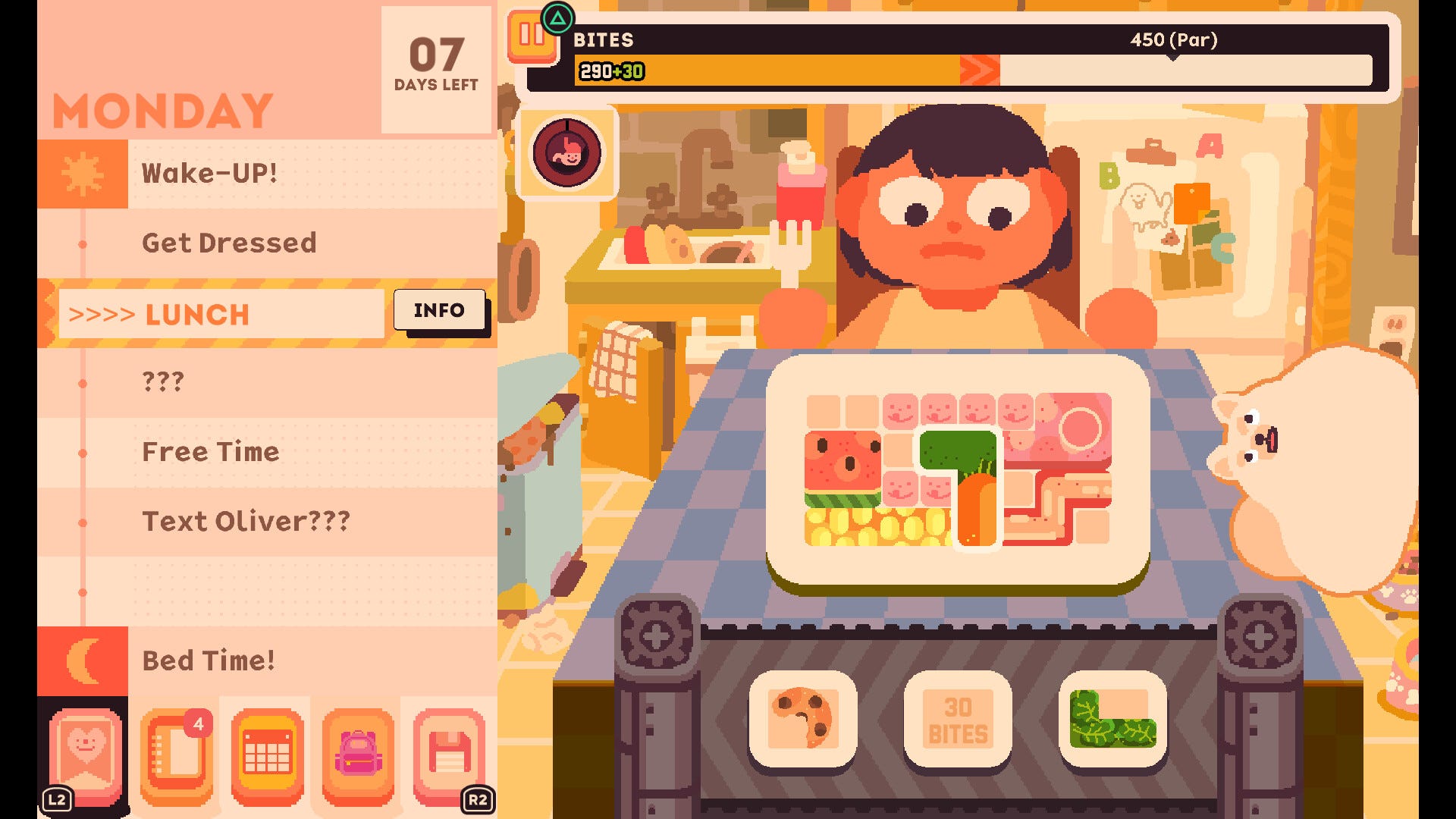
In many ways, the history of computer games is a history of simulation games. Since Microsoft Flight Sim first released in 1982, thousands of games have attempted to mimic reality in ways that are fun and engaging. The life sim is a variant made popular by Will Wright’s The Sims franchise, but which originated with games like Little Computer People (1985) and Princess Maker (1991). More recent examples like Long Live the Queen extend the spreadsheet-like gameplay seen in Princess Maker where the core mechanics revolve around managing an often overwhelming list of different stats and resources.
Consume Me combines gameplay systems typical of life sim games with WarioWare style mini games and a “darkly funny coming-of-age story”. The player must juggle a growing list of daily tasks while carefully balancing main character Jenny’s diet and hunger levels to get her through her final year of high school. The game was developed by a team of 4 and began as a prototype made in 2018 by artist Jenny Jiao Hsia at NYU Game Center in a class taught by Bennett Foddy of Getting Over It with Bennett Foddy fame.
It was later presented as a part of an exhibition titled Videogames: Design/Play/Disrupt at V&A Dundee, a museum in Dundee, Scotland. In 2019, the team received funding from Kowloon Knights, an organization that provides development money in exchange for a revenue cut, but doesn’t act as a publisher in the traditional sense as they don’t handle marketing and distribution. Kowloon Knights have supported projects with budgets that range from $100K to $10M including Sifu, Hell Clock, and Keep Driving.
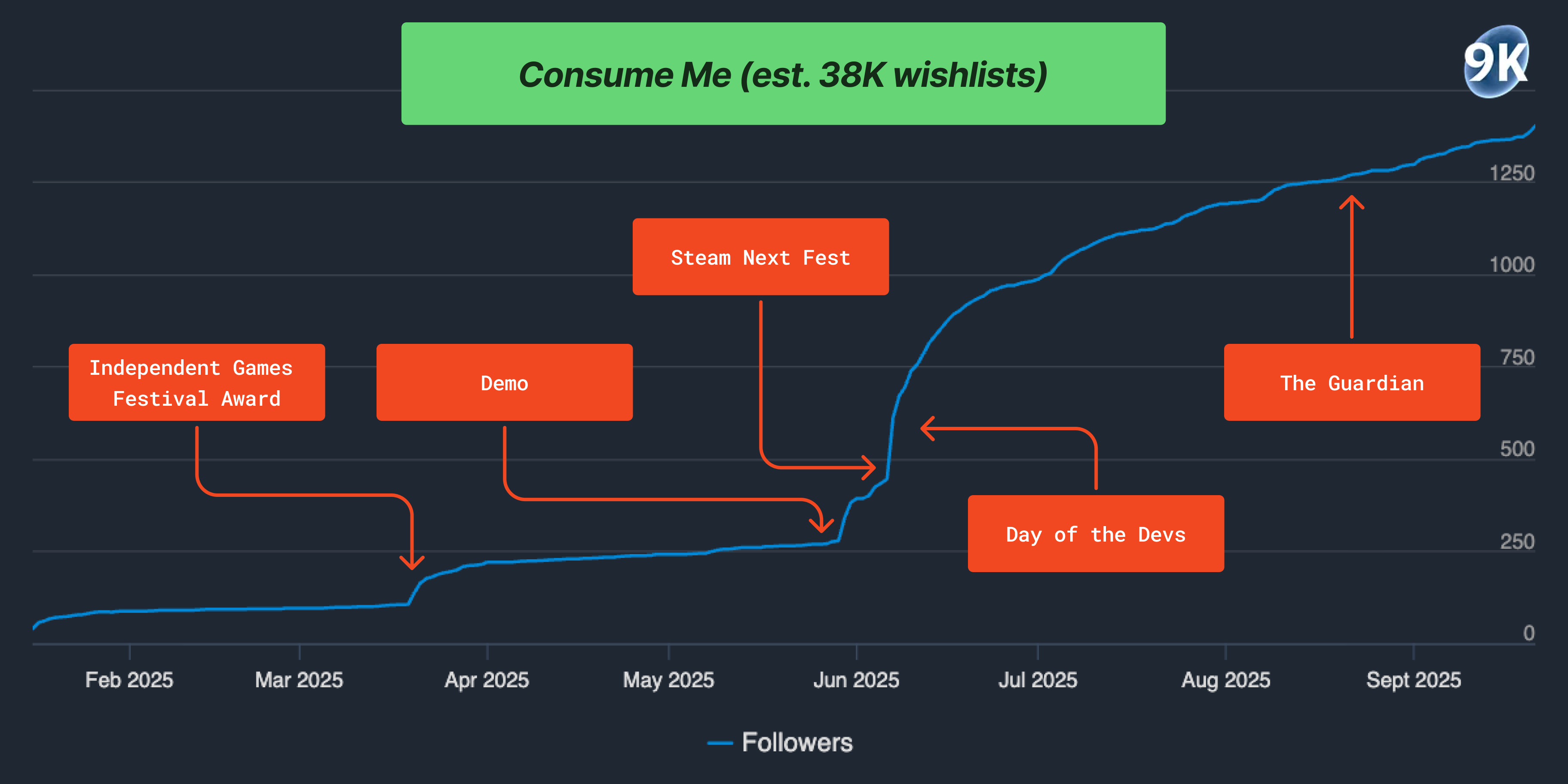
Creator and core team member Jenny Jiao Hsia has over 11K followers on Instagram and regularly posted videos throughout development promoting the game that often reached a few hundred likes. The game was covered by The Guardian in August shortly after the demo was released on Steam. It has already been a critical darling far before launch, it was the recipient of the Seumas McNally Grand Prize and the Nuovo Award at the Independent Games Festival at GDC earlier this year.
It will be interesting to see if Consume Me can find commercial success within its niche as it’s an example of a game that doesn’t fully embrace established genre conventions. It attempts to straddle the line between the systemic depth of the life sim genre, the chaotic playfulness of minigame-driven games, and narrative games with a social message. You could draw similarities to recent release to a T, which was developed by Keita Takahashi, creator of Katamari Damacy, and based on the numbers, it seems likely that the game will perform similarly. Both games reached wishlist numbers moderately above the typical discoverability threshold of 10K. to a T was well reviewed, but failed to break through selling just an estimated 4,700 copies on Steam. Consume Me could ultimately perform better among console players if it’s eventually ported to the Switch 2. Narrative driven games sometimes find a wider audience on Switch compared to Steam.
Thanks for reading and have a great week.
Excludes 30 NSFW games